About this template
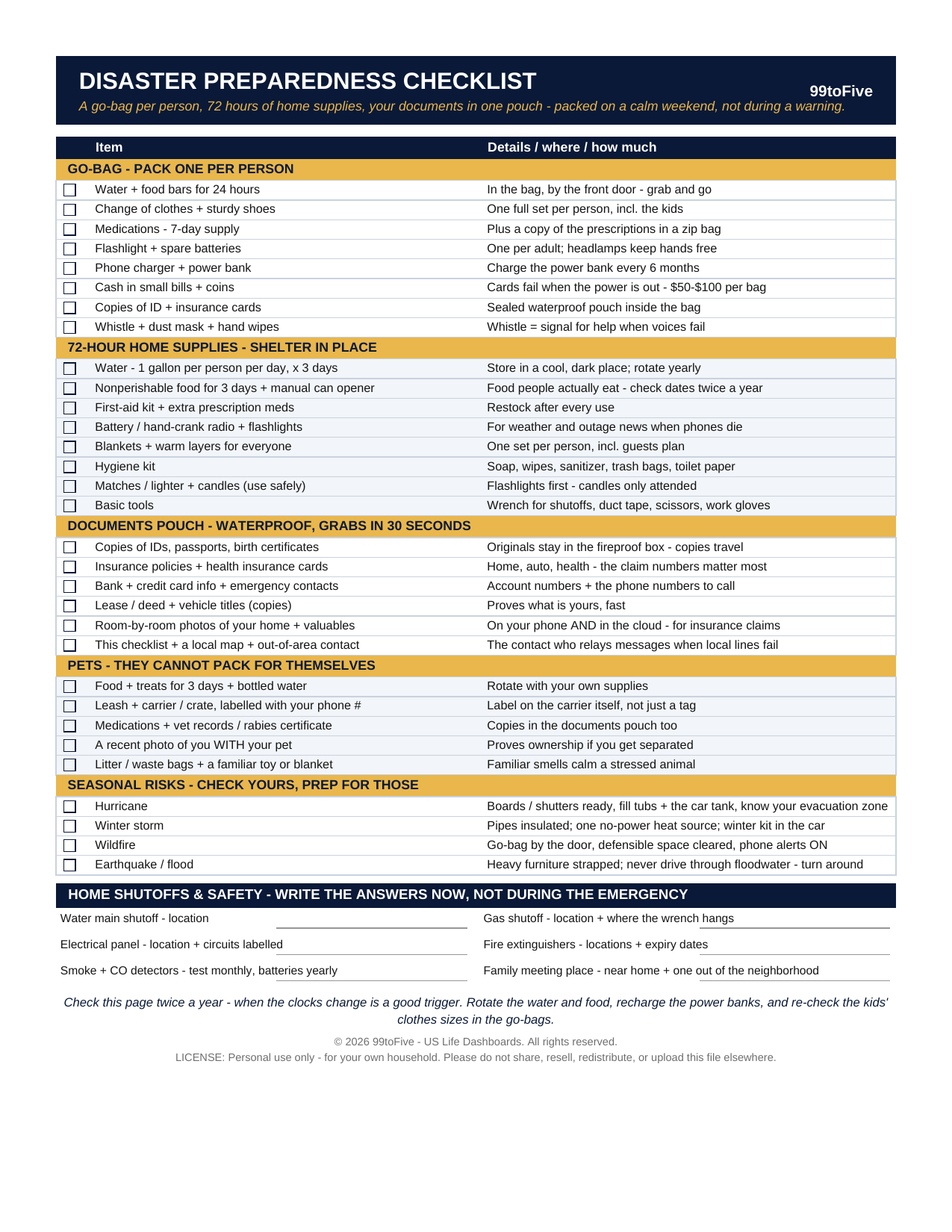
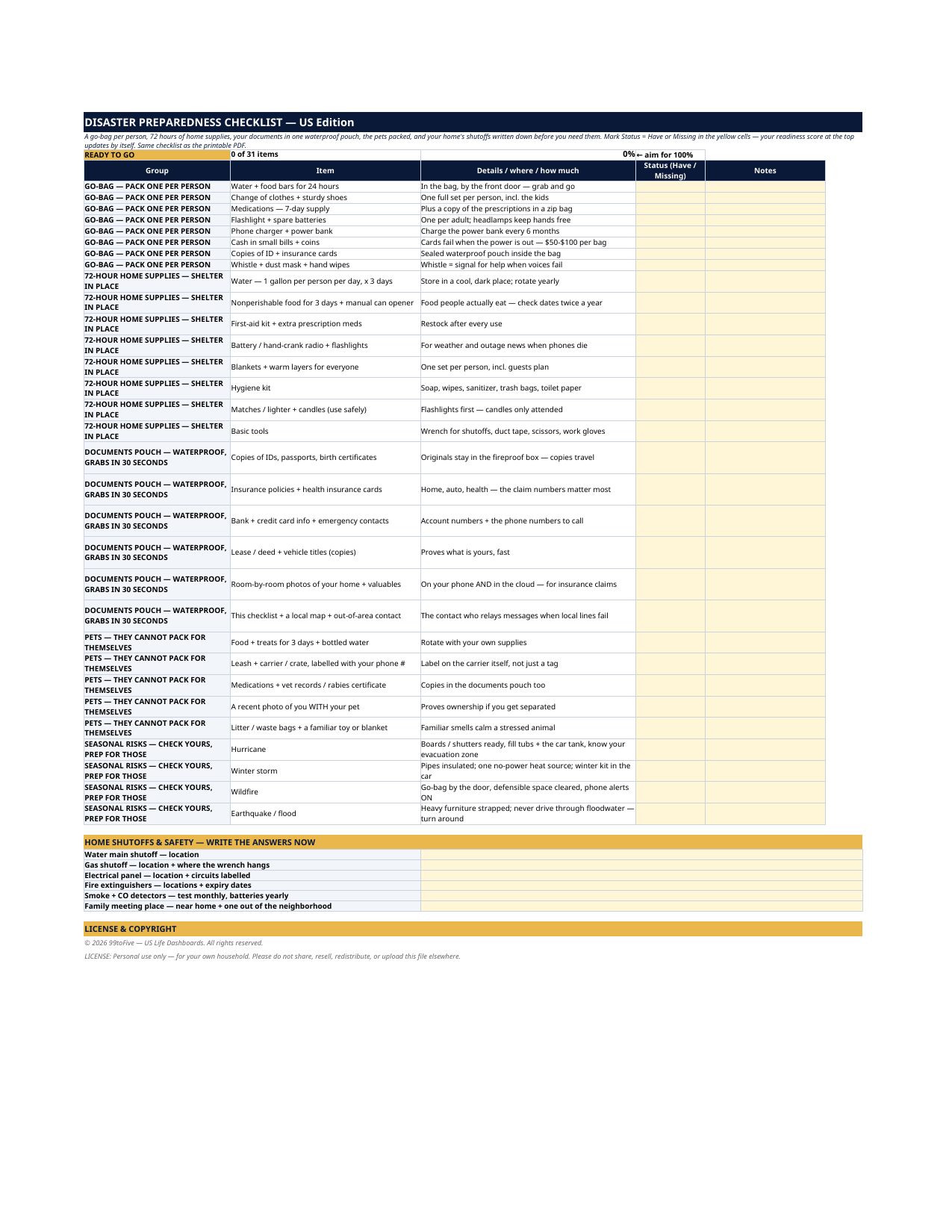
When the storm, the fire or the outage actually comes, there is no time to think of everything: the medications, the documents, the pet, the cash for when the card readers are down. This one-page checklist is the thinking, done in advance: 31 items across a go-bag for every person, 72 hours of home supplies, one waterproof documents pouch, the pets' kit, and the seasonal risks that apply where you live — plus a fill-in block for your home's shutoffs, the facts everyone scrambles for mid-emergency. You get it two ways: a printable PDF for paper-and-pen checking, and the same checklist as a spreadsheet that scores your readiness automatically.
What's inside
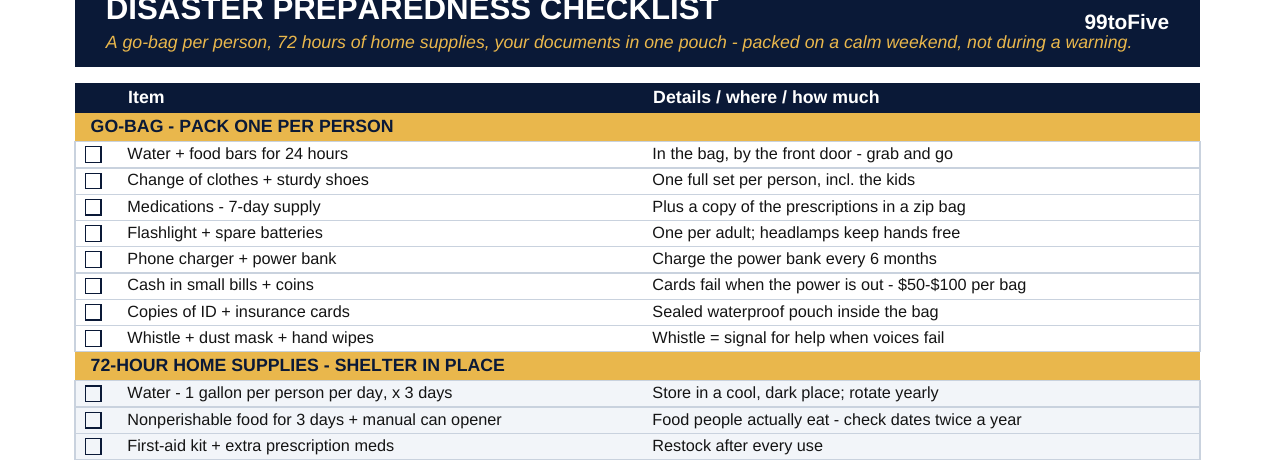
- Go-bag — ONE PER PERSON (8) — 24 hours of water and food bars, a change of clothes and sturdy shoes, a 7-day supply of medications, flashlight and batteries, charger and power bank, cash in small bills, copies of ID and insurance cards, whistle, mask and wipes.
- 72-hour Home Supplies (8) — water at a gallon per person per day for 3 days, nonperishable food and a manual can opener, first-aid kit and extra meds, a battery or hand-crank radio, blankets and warm layers, a hygiene kit, matches and candles (safely), and basic tools.
- Documents Pouch — WATERPROOF (6) — copies of IDs, passports and birth certificates, insurance policies and health cards, bank and card information with emergency contacts, lease or deed and vehicle title copies, room-by-room photos of your home for claims, and this checklist with a local map and your out-of-area contact.
- Pets (5) — 3 days of food and water, a labelled leash and carrier, medications and vet records, a recent photo of you with your pet, and litter, waste bags and a familiar blanket.
- Seasonal Risks — CHECK YOURS (4) — hurricane, winter storm, wildfire, earthquake and flood: the four prep moves that matter for each.
- HOME SHUTOFFS & SAFETY (fill-in) — water main, gas shutoff and its wrench, electrical panel, fire extinguisher locations and dates, smoke and CO detector routine, and your family's meeting places. Written down now, not during the emergency.
How it works — 3 steps
- Print the PDF (US Letter) or open the spreadsheet version.
- Go group by group: check the box (PDF) or mark Status = Have / Missing (spreadsheet), and fill in the shutoffs block while you walk the house once.
- Re-check the page twice a year — when the clocks change is the trigger printed on the sheet: rotate water and food, recharge power banks, and re-check the kids' clothes sizes in the go-bags.
You never build or fix a formula. Type only in the pale-yellow cells — the formula cells are protected (no password) so the math can't be broken by accident. Fictional SAMPLE rows, clearly marked, show you the format; delete them and the file is yours.
What you need
For the PDF: any PDF reader, and a printer if you want the paper copy. For the spreadsheet: Microsoft Excel, or Google Sheets (free with a Google account). The same .xlsx file works in both — upload it to Google Drive, open it, File → Make a copy, and work in your copy. The spreadsheet version is the only part that needs Excel or Sheets; the printable PDF works anywhere.
Instant download
This is a digital download — no physical item will be shipped. After purchase, go to Etsy → Purchases and reviews → Download files, save the file to your computer first, then open it in Excel (click “Enable Editing”) or upload it to Google Drive for Sheets (then File → Make a copy, and always work in your copy).
License
Personal use only — for your own household. Please do not share, resell or redistribute the file.
Questions
What exactly do I receive?
Two files: a one-page printable PDF (US Letter) with checkboxes and a shutoffs fill-in block, and the same 31-item checklist as an Excel spreadsheet with Status and Notes columns and an automatic readiness score at the top.
Do I need Excel or Google Sheets?
Only for the spreadsheet version. The PDF prints and works with any PDF reader — if you only want the paper checklist, you're all set.
How does the spreadsheet score work?
Type "Have" or "Missing" in the yellow Status cells. The scoreboard at the top counts you — it starts at "0 of 31 items, 0%" and the aim, printed right there, is 100%.
Is 72 hours the right target?
It's the standard planning baseline used by US emergency agencies for sheltering in place: three days of water, food and basics per person. The go-bag section covers the other case — having to leave fast — with 24 hours per person plus medications for a week.
We don't live in a hurricane or earthquake zone. Is this still for us?
Yes — the most common emergencies are house fires, power outages and winter storms, and the go-bag, supplies and documents sections are built for those. The seasonal group is explicitly "check yours": prep only for the risks where you live.